
Written by: Mati
For many years, I kept hearing the same comment: “The Master’s Touch is such a beautiful book, but it’s difficult to read alone.” After completing Sagarpriya’s training, I understood the book much more deeply. Even so, I still found it challenging to sit down by myself and truly absorb it, one page at a time. Many people told me, “I bought the book because I love it, but it’s still sitting on my shelf. I haven’t been able to read it. That inspired me to start a weekly reading circle—not as a study group, but as a space where we could slow down, read together, and allow the words to touch us.
We meet every Wednesday, once a week, and we read together for about 30 minutes. The meetings lasts around 40 minutes. We begin and end with a short meditation. And once a month, after reading, we hold a sharing circle where everyone reflects on what has touched them and how the book is unfolding in their own lives.
Participants often say:
- ”It feels like meditation through reading.”
- “The quality of my sleep has improved.”
- “Sometimes the words touch my heart so deeply that I find myself in tears.”
- “It gives me a rare experience of silence that is difficult to find in everyday life.”
- “I’m beginning to experience more joy in my daily life.”
- “It inspired me to learn Psychic Massage.”
- “I’m finally beginning to understand the depth of this work.”
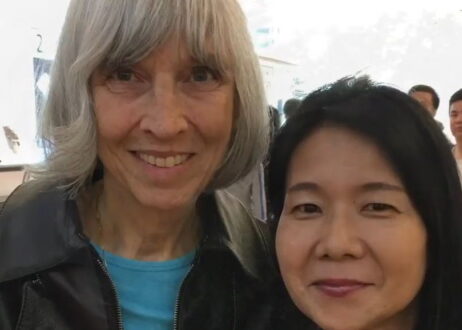
For me, The Master’s Touch—and Psychic Massage—is where everything began. In 1987, I attended Sagarpriya’s group in Japan for the first time. From that moment, I fell in love with her presence. Later, when I met Osho in India, I realized something profound: it was the Osho energy I had already felt through Sagarpriya that had drawn me all the way to India. From then on, I studied Psychic Massage and Star Sapphire with her in both India and Italy, and later had the privilege of inviting her to Japan to share her work.
At her final group in Japan in 2017, several sannyasins who had received sessions from her nearly thirty years earlier said: “At the time, I was upset by what she told me. Only now do I finally understand.”
For many Japanese sannyasins Sagarpriya was like a Zen master—direct, uncompromising, and deeply compassionate. I can never forget something she said about me in front of the group.
“Mati is elegant, yet there’s also something a little hippie about her. Even when she’s beautifully dressed, there will be a loose thread somewhere.” It felt as if she had perfectly described both my feminine and masculine energies. It still makes me smile.
When she left her body in January 2026, nearly one hundred friends gathered online for a Death Celebration to honor her life and everything she had shared with us. Even now, I feel her presence.
Her spirit lives on through this book, through the work she created, and in the hearts of all those whose lives she touched.